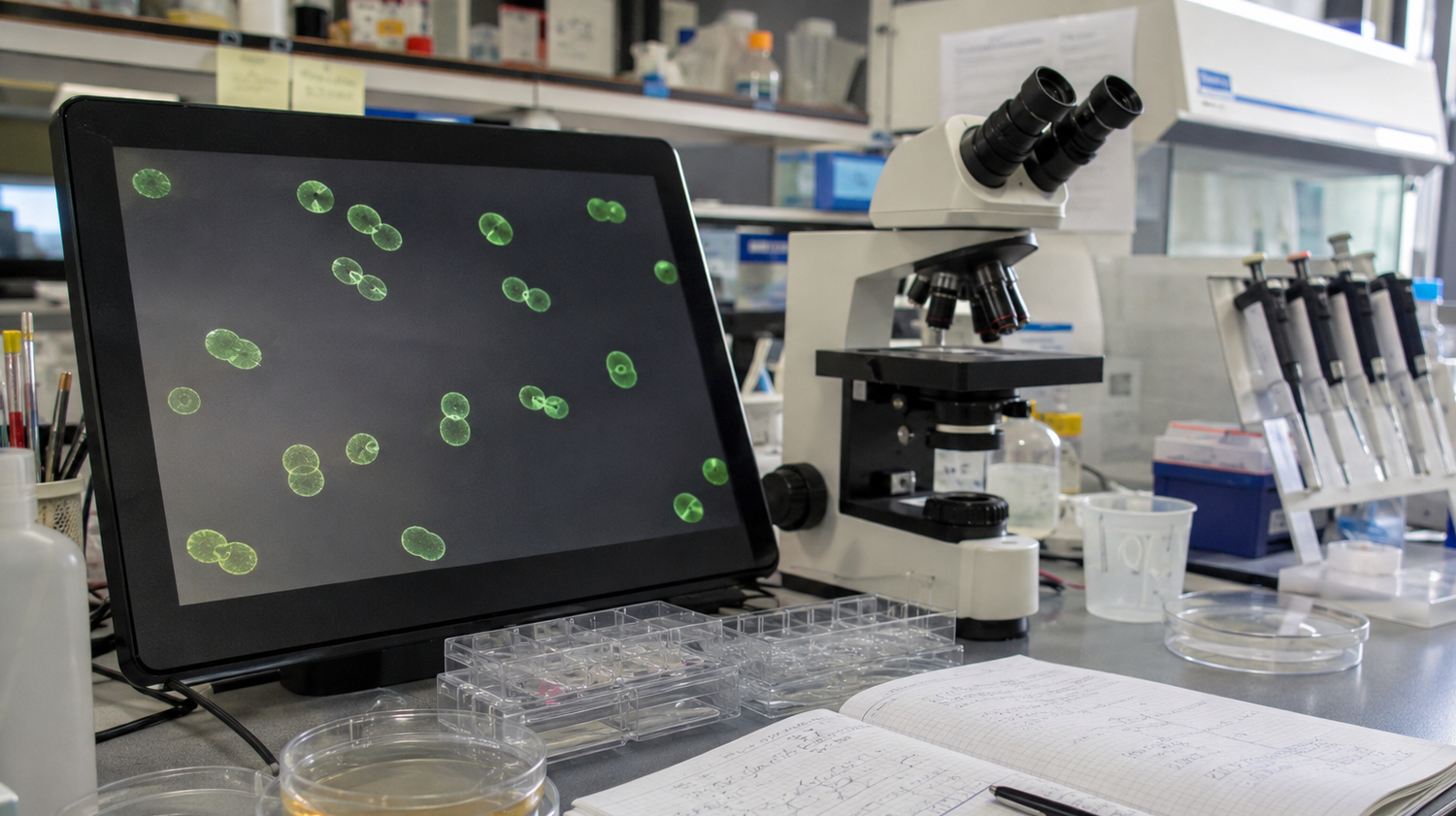
A Breakthrough at the Edge of Life
In a major step for synthetic biology, researchers at the University of Minnesota led by Kate Adamala and Aaron Engelhart have developed a synthetic cell-like system called SpudCell. It is not a fully living cell in the traditional biological sense, but it is one of the most advanced attempts yet to build life-like behavior from non-living chemical components.
SpudCell is significant because it can perform several behaviors usually associated with living cells: feeding, growing, copying genetic material, dividing, and showing a form of selection across limited generations.
What Is SpudCell?
SpudCell is built from the bottom up. Unlike earlier approaches that modified or minimized existing living cells, this system is assembled from known components, including lipid membranes, synthetic DNA, enzymes, ribosomes, and other molecules needed to run basic cellular processes.
The system contains a membrane that mimics the boundary of a cell, a relatively small genome distributed across several DNA molecules, and a defined protein expression system that can read genetic instructions and produce proteins needed for growth and division.
Why It Matters
For decades, scientists have asked a fundamental question: when does chemistry become life? Natural cells are extremely complex, making it difficult to identify which parts are truly essential and which are the result of billions of years of evolution.
SpudCell gives researchers a simpler and more transparent platform. Every component is known, and each function can be studied directly. This makes it a powerful tool for exploring the minimum requirements for life-like behavior.
It Grows and Divides, but It Is Not Fully Alive
Although SpudCell can grow, replicate genetic material, and divide, it is still far from a natural living cell. It depends on a nutrient-rich environment and external molecular machinery. It does not yet have fully independent metabolism or long-term self-sustaining reproduction.
Its performance is also limited. It is slower, less efficient, and less stable than natural cells, and it can break down after only a few generations. For that reason, it is more accurate to describe SpudCell as a synthetic cell-like system with a complete cell cycle, rather than a fully independent living organism.
From Understanding Life to Engineering It
The long-term potential of this work is considerable. More robust synthetic cells could one day help produce medicines, build biological materials, model diseases, or act as microscopic factories operating under gentler conditions than traditional chemical manufacturing.
However, major challenges remain. SpudCell needs a more stable genome, better control over feeding and division, and more advanced systems for managing energy and waste. The field also needs shared standards so researchers can develop synthetic cells safely and collaboratively.
Conclusion
SpudCell is an important milestone in the effort to understand life as an engineering system. It does not prove that scientists have created fully independent life from scratch, but it does show that core life-like behaviors can be reconstructed from non-living chemical parts.
This breakthrough changes how we think about the cell. It opens the door to a new era of synthetic biology, where scientists do not only modify existing life, but work to understand its rules deeply enough to build new biological systems from the ground up.